


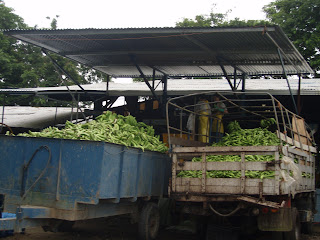
This picture below shows the banana's not going to be exported and sold within the country.

I have finaly learned something about banana's. We visited the Chiquita banana plantation where i learned a lot more about how banana's are produced. First of all, banana's are not native to the tropics region and that is why they require many fungisides, herbisides, and pesticides. These are dangerious chemicals that can be very harmful to humans and to the surrounding eco-system. Chiquita told us how they are being "less-bad" and trying to control these factors. Chiquita is currently the second largest banana producer behind Dole. In the fields, banana's have a blue bag around them to protect them from bugs and from the harsh sunlight. Chiquita, unlike most other producers, recycle the bags. The processing/ packaging plant was pretty interesting to see.
The banana's are now being sprayed with the "less harmful" chemicals than in the past and workers are required to wear extensive equipmeent, where as other plantations, neither of these precautionary measures have been taken. Chiquita is commited to environmental sustainability. The banana's are chopped off at the stem and the whole stem is sent down a line, kind of like a ski lift, where it is then taken off at the packaging plant. They are then counted and weighed and cleaned for ten minutes. The banana's are also checked for quality where the flawless ones are sent off for europe, USA, and Asia and the ones with some flaws are thrown on a truck right away before being cleaned because they will be sold in Costa Rica under another label (or exported under another label)and some will be sent to make a banana puree for baby food, etc. After being cleaned, the banana's are sent down the factory to be either cut individualy or in bunches for packaging. The banana's all look very green and very tasty, they do not have any imperfections. They are then loaded on a truck and sent to be exported around the globe. Depending on the destination, the banana's arrive in the market between 3 and 11 days. The banana's are shipped at low temperatures to slow the ripening process.
The Chiquita Banana show was very interesting at best. Kind of the same thing as the Cafe Britt show, but a lot less organized. Basically a bunch of Tica women came out and danced and try to explain how banana's came to costa rica all of which was in spanish. i did take a video of the dancing chiquita banana girl.

