Coffee in Costa Rica... we have been to Daisy's coffee plantation, Cafe Britt, and seen all the other coffee fields that Costa Rica is covered in. Costa Ricans take much much pride in their product. Coffee, aka the grain of gold. Costa Rica produces a couple different types of coffee, although it is all from the Arabica plant. Cafe La Carpintera, Cafe Atarazu, Cafe El Gran Vito, Cafe Zurqui, Cafe Ujarraci, and Cafe Buena Vista are all grown in different areas and in varying altitudes. The Cafes La Carpintera and Atarazu are Strictly Hard Bean coffees and grown in Tres Rios and Terrazu respectively and have the same harvest of November through February. Cafe Atarazu is the coffee with the highest elevation reaching 1750mts. Cafe El Gran Vito is a medium hard bean and grown in altitudes ranging from 800-1200 mts. Its harvest season is October through December. Cafe Zurqui is a strictly hard bean coffee grown in the Heredia region at an altitude ranging from 1200-1500 mts. Its harvest is from November to February and well known for unique coffee with high acidity, very good body and aroma. Cafe Ujarraci is a High Grown Atlantic coffee grown in the Cachi area at an altitude from 900-1200 mts and a favorite for American, European, and Japanese gourmet coffee drinkers. Last but not least is the Cafe Buana Vista grown in the San Isidro del General region at an altitude of 400-1200 mts. Cafe Buena Vista is a Medium Hard Bean harvested from October to December and grown in the most impressive mountain region of Costa Rica. (http://www.costaricamap.com/ing/aboutcafe.html)
A SHB or strictly hard bean is one of the best coffees in the world. Its grain is blue, bright and big. (says BBC online)
Tuesday, June 10, 2008

Ecotourism 4
Coming into this trip, I did not grasp the concept of eco-tourism at all. After being to all the different national parks and reserves, I understand the importance of ecotourism compared to eco-destructive tourism. I am going to make a comparison to the leaf cutter ants. The tourism industry needs to use "biomimicry" as a model. the leaf cutter ants work together to be 100% sustainable. They form a line using a scent and cut the leaves off of plants, take the leaves down underground so that they may decompose enriching the soil so that fungus may grow. They then live off this fungus for food creating their own food, and creating food for others by enriching the soil. Another part of the ants is that everyone is involved, no one is left out of the system. If tourism as a whole could be more sustainable and feed on their own (like at the Osa with the pig and the vegetable gardens), and reduce pollution to almost nothing, they would be wonders for the world.
Strides need to be made so that ecotourism, where the environment remains intact and unharmed, and tourism can become one, and the environment does not have to suffer. Costa Rica is one of the first and foremost on ecotourism but also contributes wasteful tourism as-well. We need more environmentally friendly hotels and resorts.
Many controversies as of recent have arisen due to construction of hotels and beach resorts within the 50m protected maritime public zone. Construction has even been in protected areas. The effects of the environment to existing flora and fauna has been horrible. The dumping of construction waste created by non-ecotourism has damaged many coral reefs and mangroves. This is just another example why ecotourism is the way to go and why it is the fastest growing tourism sector.
Banana's round 4


As we already know, with the standard fruit co, chiquita, and dole, Banana's are a large part of Costa Rica's economy. According to Bananaexport.com (its in spanish), Costa Rica an area with the highest incidence of agrochemical sprays with 54 cycles of spraying. This amount of spraying is due to worry about a certain deadly fungus that is sweeping/ swept through central and south america, the fungus is called the black sigatoka fungus. The first outbreak of this deadly fungus was reported in 1972 in La Hima, Honduras. The fungus then spread north and south. This fungus is only one of the reasons the non-native banana plant requires so much agro chemical spraying in Central America. The only method to control the fungus is spraying, which account for about 25% to 30% of production costs. It has been reported that the fungus is continually fighting fungicides and more research is much needed.
In addition, i would like to go back to Chiquita's banana production and how they are the first to become more-sustainable and their relationship with the Rainforest Alliance. Chiquita currently owns 37,000 acres of banana farms in Panama, Costa Rica, Hinduras, and Guatemala. In 2004 alone, Chiquita shipped 136 million boxes of banana's to the US, Europe, Middle East, and Asia. Chiquita currently employs more than 25,000 people. Chiquita got their first farms certified by the rainforest alliance in 1994. Since 2000, the company has been rewarded with 100% Rainforest Alliance certification on all company owned farms, and 80% on independent farms that sell to Chiquita.
Chiquita ensures human rights and labor rights for all its workers. They have no child labor or forced labor. They ensure safe working conditions and freedom of association and collective bargaining. Compensation for workers meets at least legal or industry minimum standards.
Rainforest Alliance auditors visit farms at least once a year to ensure cooperation with strict environmental standards that include, using minimal pesticides, protection of wildlife, conservation of water and soil, environmental education, fair pay, adequate housing and safe working conditions, and zero tolerance for deforestation. In an effort to connect forests, Chiquita has planted at least 1 million trees along rivers, lakes, roads, and in residential and industrial areas. Water is monitored regularily and prevents organic waste from polluting streams and rivers. All agro chemicals used are approved for use on banana's by the US EPA and EU.
Lizard


This is going to be a short post, but i was reading in my room, and i look up and there is a lizard right above my on the ceiling in my room and my home stay. i was scared or anything (obviously), but it just shocked me. I got Bob and we tried to scare it away but it wouldnt leave. So long story short, we got our homestay-brother (Juan Jose) to deal with it. here are some pictures and a video.
Coffee Round 3
I have some more observations about coffee in costa rica. Coffee seems to be sold at any gift shop and most tourist shops. This gives me the sense that coffee is really good here. I myself am not a coffee drinker but i think the whole pitch about how Costa Rican coffee is of higher quality than the competition is certainly correct. Also, coffee is cheaper on many restaurant menu's than water in most cases i have noticed. Coffee is very cheap within the country because it is so readily available.
I have extended my research on coffee in Costa Rica and was interested to find out how and who decides what is good coffee in Costa Rica. Many coffee competitions take place, such as the one Daisy one with her Del Cafe Tal. Costa Rica has the Specialty Coffee Association of Costa Rica(SCACR) and the Costa Rican Coffee Institute (ICAFE). These two organizations rank coffee in Costa Rica and establish a winner. This is only one of the things that they do, they also increase the quality culture in the Costa Rican companies, improve quality among growers, promote quality consistency, and achieve differentiation in the market. SCACR was founded in 1993 for growers, millers, toasters, and local exporters to furnish Costa Rican coffee to the international gourmet coffee markets. I almost think of this organization as a lobbyist for Costa Rican coffee and promote the quality and distinctness of coffee in Costa Rica.
Monday, June 9, 2008
Ecotourism 3


While at the Osa Peninsula, we did lots and lots of ecotourism. We went on extensive nature walks at the national park and also went snorkeling. While on the nature walks, our guide was great and showed us plenty of animals. We saw howler monkeys and spidermonkeys and lots of leaf cutter ants. We saw some beautiful birds aswell. Our whole trip to the Osa was very eco-friendly. The place we stayed at was helpful to the economy because they were partially sustainable. All the scrap food that we did not eat at the meals was fed to the pig they have and the pig was later used too! Snorkeling on the island off of the peninsula was also an example of eco-tourism and we saw some beautiful fish and coral reef.
Its no wonder ec0tourism is the fastest growing sector in the tourism industry. The snorkeling and nature hike was beautiful. Where else can you see monkeys in their natural habitat?
The whole Osa Peninsula was very ecotouristy because it lacked much urbanization. We felt as though we were cut off from the rest of the world. No towns or cities were anywhere near us, and we needed a boat to get to our camping site. Ecotourism is tourism without phones, tv's, and power. Although we did have power, everything else was cut off and we felt independent. We were not polluting the rivers or air with pollution during our stay, we were basically camping out. Normal hotels on beaches and what not would not be friendly to the environment, and thats why other tourism is not called eco-tourism.
Banana round 3


This picture below shows the banana's not going to be exported and sold within the country.
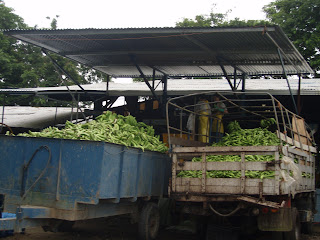

I have finaly learned something about banana's. We visited the Chiquita banana plantation where i learned a lot more about how banana's are produced. First of all, banana's are not native to the tropics region and that is why they require many fungisides, herbisides, and pesticides. These are dangerious chemicals that can be very harmful to humans and to the surrounding eco-system. Chiquita told us how they are being "less-bad" and trying to control these factors. Chiquita is currently the second largest banana producer behind Dole. In the fields, banana's have a blue bag around them to protect them from bugs and from the harsh sunlight. Chiquita, unlike most other producers, recycle the bags. The processing/ packaging plant was pretty interesting to see.
The banana's are now being sprayed with the "less harmful" chemicals than in the past and workers are required to wear extensive equipmeent, where as other plantations, neither of these precautionary measures have been taken. Chiquita is commited to environmental sustainability. The banana's are chopped off at the stem and the whole stem is sent down a line, kind of like a ski lift, where it is then taken off at the packaging plant. They are then counted and weighed and cleaned for ten minutes. The banana's are also checked for quality where the flawless ones are sent off for europe, USA, and Asia and the ones with some flaws are thrown on a truck right away before being cleaned because they will be sold in Costa Rica under another label (or exported under another label)and some will be sent to make a banana puree for baby food, etc. After being cleaned, the banana's are sent down the factory to be either cut individualy or in bunches for packaging. The banana's all look very green and very tasty, they do not have any imperfections. They are then loaded on a truck and sent to be exported around the globe. Depending on the destination, the banana's arrive in the market between 3 and 11 days. The banana's are shipped at low temperatures to slow the ripening process.
The Chiquita Banana show was very interesting at best. Kind of the same thing as the Cafe Britt show, but a lot less organized. Basically a bunch of Tica women came out and danced and try to explain how banana's came to costa rica all of which was in spanish. i did take a video of the dancing chiquita banana girl.
Subscribe to:
Posts (Atom)
